What Is Solar Self-Consumption? A Complete Guide to How HomeSolar Works
If you’re researching solar panels for your home, you’ve probably run into the term «solar self-consumption» and wondered exactly what it means. In simple terms, self-consumption refers to the portion of solar energy your home uses directly, as it’s being generated, rather than sending it back to the grid. Understanding this concept is the foundation for everything else you’ll evaluate about home solar — from system sizing to savings estimates to whether a battery makes sense for your household.
This guide breaks down how home solar actually works, from the moment sunlight hits your roof to the moment it powers your refrigerator or gets credited on your utility bill.
The Basics: How Solar Panels Generate Electricity
Solar panels are made of photovoltaic (PV) cells, typically built from silicon. When sunlight hits these cells, it knocks electrons loose, creating an electric current. This is called the photovoltaic effect, and it’s the same basic principle whether you’re looking at a small panel on a calculator or a 20-panel array on your roof.
The electricity your panels produce is direct current (DC), but the appliances in your home run on alternating current (AC). That’s where the inverter comes in — it’s the device that converts the DC electricity from your panels into the AC electricity your home actually uses. Without an inverter, the power your panels generate would be unusable for standard household appliances.
What «Self-Consumption» Actually Means
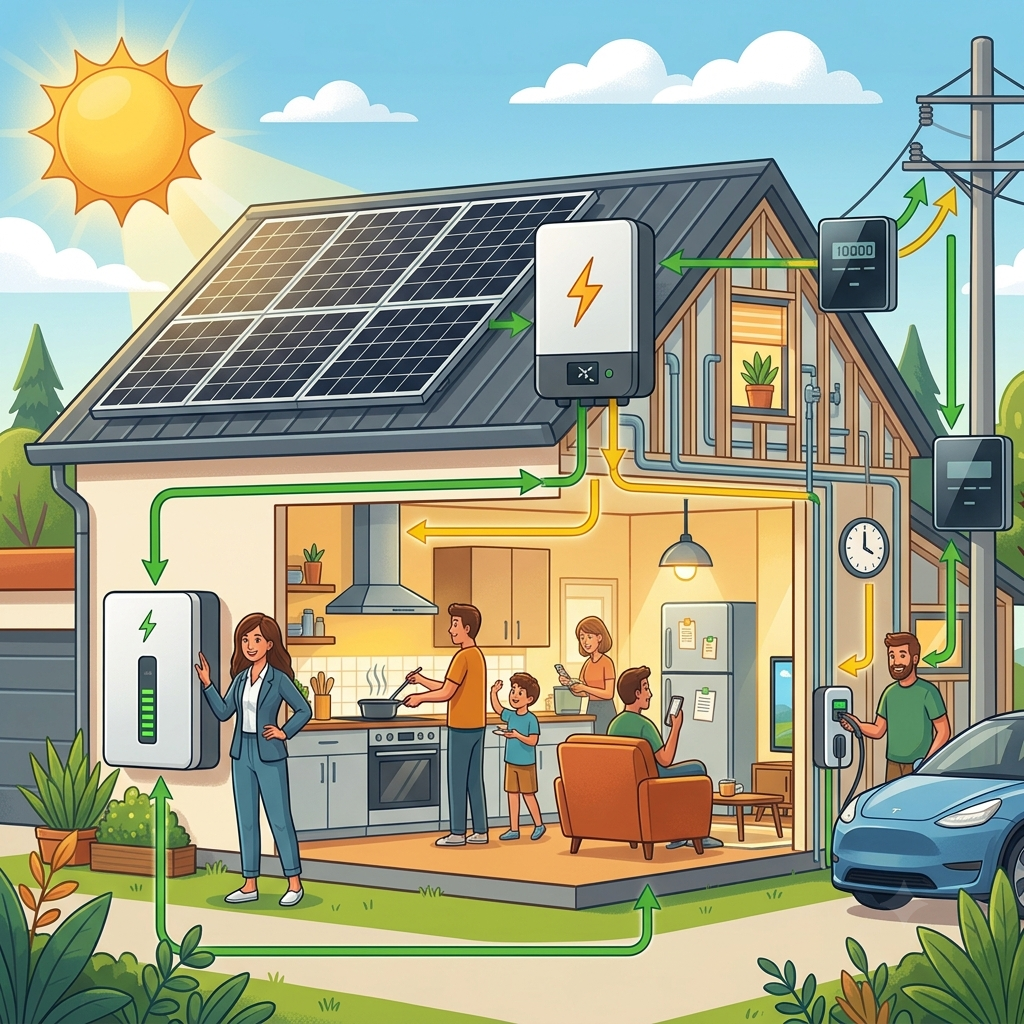
Once your system is producing usable AC electricity, that power has to go somewhere. Self-consumption is the share of that electricity your home uses in real time — while you’re running the air conditioner, charging devices, or using the dishwasher during daylight hours.
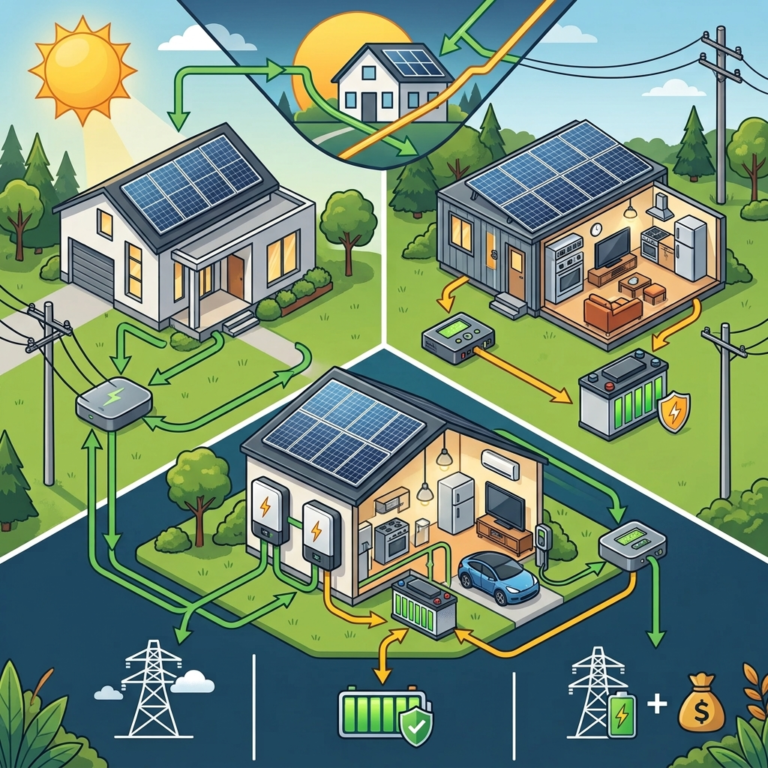
Any solar electricity you generate but don’t use immediately doesn’t just disappear. Depending on your system setup, it either:
- Flows back into the utility grid, where it may earn you credits through net metering (more on this below), or
- Charges a home battery, if you have one installed, for use later in the day or at night.
Your self-consumption rate is essentially a percentage: how much of your total solar production is used directly by your home versus exported elsewhere. A household that’s mostly empty during the day (everyone at work or school) will typically have a lower self-consumption rate than a household with someone home using appliances throughout daylight hours.
Why Self-Consumption Matters for Your Savings
This distinction matters more than most homeowners initially realize, because the financial value of solar electricity isn’t always the same depending on where it goes.
Electricity you self-consume directly offsets what you’d otherwise buy from your utility at the full retail rate. This is generally the most valuable use of your solar production.
Electricity you export to the grid is usually credited at a different rate, depending on your state’s net metering or net billing policies. In many states, exported solar is now credited at a lower rate than the retail price you’d pay to buy electricity back — a shift that’s become more common as utilities update their net metering rules. This means maximizing self-consumption, rather than simply maximizing total production, is often the smarter financial strategy.
This is one reason system sizing has become more nuanced. In the past, it often made sense to size a system large enough to cover 100% of annual usage through net metering credits. Today, in many states, it can make more financial sense to size a system closer to your daytime usage pattern, or to add a battery, so more of your production is consumed directly rather than exported at a lower credit rate.
Grid-Tied Systems and How They Handle Excess Power
Most residential solar systems in the U.S. are grid-tied, meaning they remain connected to the utility grid rather than operating independently. This setup allows homeowners to draw power from the grid when their panels aren’t producing enough (like at night or on overcast days) and to send excess power back to the grid when they’re producing more than they’re using.
This back-and-forth relationship with the grid is what net metering programs are designed to track and credit. When you export power, your utility typically records it, and you receive some form of credit — either at the retail rate, a reduced «avoided cost» rate, or a time-based rate, depending on your state and utility.
Because these programs vary significantly by state, and because many have been revised in recent years, it’s worth checking your specific state’s current net metering or net billing rules before finalizing how you want your system sized.
The Role of Batteries in Boosting Self-Consumption
A home battery, such as a Tesla Powerwall or similar product, stores excess solar electricity instead of sending it straight to the grid. That stored power can then be used in the evening, overnight, or during a grid outage.
Adding a battery is essentially a direct way to increase your self-consumption rate. Instead of exporting midday solar production for a modest credit and then buying electricity back at full price after sunset, a battery lets you store and use that same solar power yourself later in the day.
Batteries add upfront cost, so they’re not automatically the right choice for every household. Whether one makes financial sense depends on factors like your state’s net metering rate structure, whether your utility uses time-of-use pricing, how often you experience power outages, and your overall budget. For many homeowners, this is a «phase two» decision made after the core solar system is already installed and generating savings.
A Simple Example
Picture a household with a 7 kW solar system. On a sunny day, the system produces electricity steadily from mid-morning through late afternoon. If the homeowners are running the air conditioner, doing laundry, and using other appliances during that window, a large share of that solar production is consumed directly — true self-consumption.
Any production beyond what the home uses in that moment either gets exported to the grid (earning a credit under net metering) or, if a battery is installed, gets stored for use once the sun goes down. At night, with no solar production, the home draws electricity either from the grid or from the battery, depending on the system setup.
Over a full billing cycle, the home’s utility bill reflects a mix of: electricity offset directly by self-consumption, credits earned from exported solar, and electricity purchased from the grid during low-production periods.
Key Terms to Know Going Forward
As you continue researching home solar, you’ll run into a handful of related terms that build directly on the concept of self-consumption:
- Net metering: The billing arrangement that credits you for solar electricity exported to the grid.
- Grid-tied vs. off-grid vs. hybrid systems: Different ways a solar system can be connected to (or disconnected from) the utility grid.
- System sizing: Determining how many panels/kW of capacity your home needs, based on usage patterns and goals.
- Time-of-use rates: Utility pricing that varies by time of day, which can significantly affect the value of self-consumption versus exported power.
The Bottom Line
Solar self-consumption is the foundation concept behind how home solar systems actually deliver savings. Rather than thinking of your panels as simply «producing electricity,» it’s more accurate — and more useful for planning — to think about when that electricity is produced relative to when your household uses it. That relationship determines how much value you get directly, how much you get through grid credits, and whether a battery is worth adding to your setup.
Understanding self-consumption is the first step toward making smarter decisions on system size, battery investment, and realistic savings expectations — all of which we’ll cover in more detail in the related guides linked below.