Grid-Tied vs. Off-Grid vs. Hybrid Solar Systems: What’s the Difference
Not all home solar systems work the same way. Before you get a quote or start comparing equipment, it’s worth understanding the three basic system types: grid-tied, off-grid, and hybrid. The right choice affects your upfront cost, your savings potential, and how your home behaves during a power outage — so it’s one of the first decisions that shapes everything else about your solar project.
Grid-Tied Systems: The Most Common Choice
A grid-tied (or «grid-connected») system is exactly what it sounds like: your solar panels remain connected to the utility grid at all times. This is by far the most common setup for U.S. homeowners, and for most people, it’s the default option any installer will quote first.
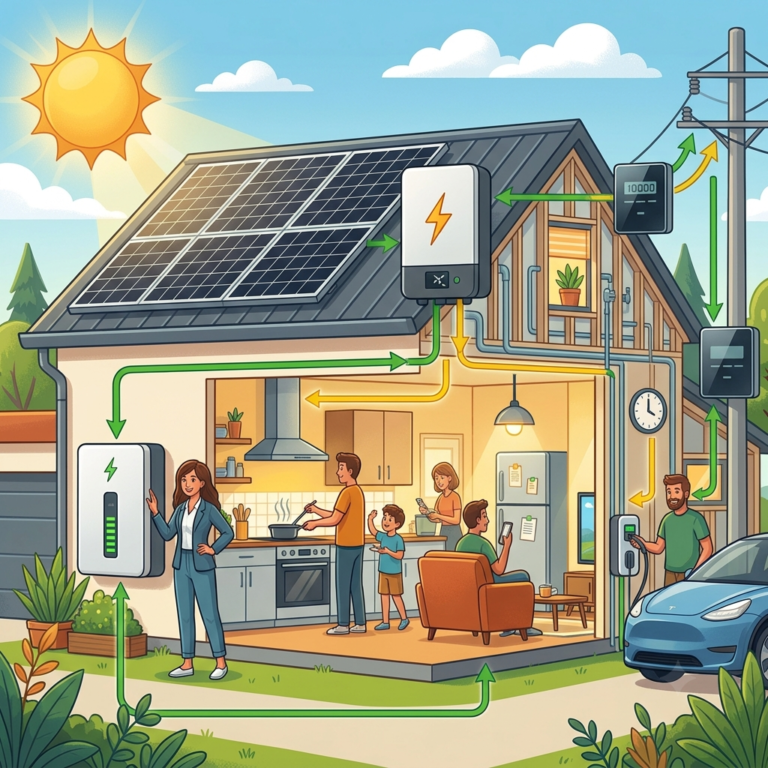
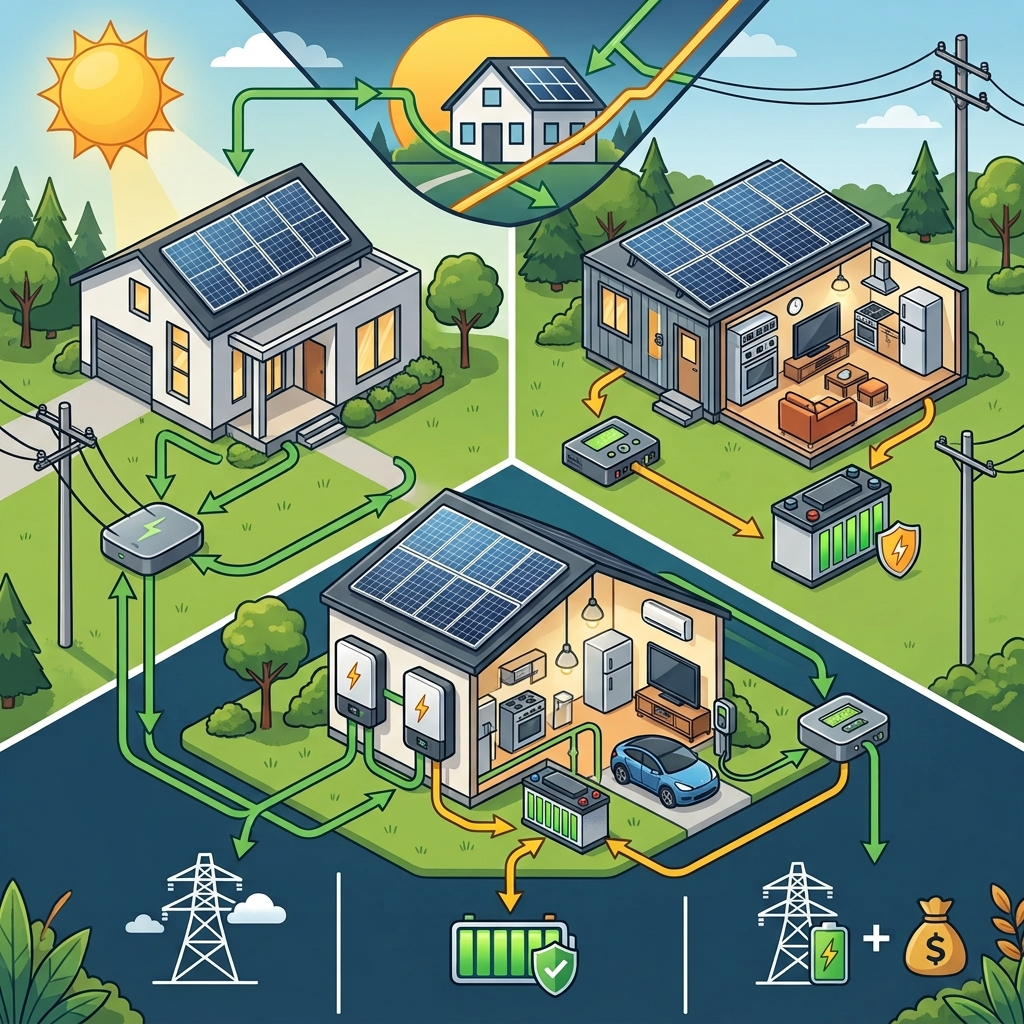
How it works: During the day, your panels generate electricity that your home uses directly. Any excess production gets exported to the grid, typically earning you a credit through net metering. At night or on low-sun days, when your panels aren’t producing enough, your home simply draws power from the grid as usual.
Advantages:
- Lowest upfront cost of the three system types, since there’s no battery to buy.
- Simplest installation and maintenance.
- You benefit from net metering credits, effectively using the grid as a «free» storage system for excess production.
- No need to worry about running out of stored power — the grid is always there as backup.
The trade-off: A standard grid-tied system without a battery will shut off automatically during a grid power outage. This is a safety requirement (it prevents your system from sending electricity back into lines that utility workers may be repairing), but it means grid-tied homes lose power right along with their neighbors during an outage, even though there are solar panels sitting right on the roof.
Grid-tied systems make the most sense for homeowners whose primary goal is reducing their electric bill and who aren’t especially concerned about backup power during outages.
Off-Grid Systems: Full Independence
An off-grid system has no connection to the utility grid at all. Every bit of electricity the home uses has to come from the solar panels themselves or from a battery bank charged by those panels.
How it works: Solar panels charge a battery bank throughout the day. The home draws all of its electricity from that battery, which is recharged daily by the panels. Because there’s no grid to fall back on, off-grid systems are typically sized generously, with enough battery capacity to get through several cloudy days in a row, and sometimes a backup generator for extended low-production periods.
Advantages:
- Complete independence from the utility company — no monthly electric bill, no grid dependency.
- The only realistic option for genuinely remote properties where grid connection isn’t available or would be prohibitively expensive to install.
The trade-offs:
- Significantly higher upfront cost, since the system needs enough battery capacity and panel capacity to cover the household’s needs year-round without any grid support.
- Requires careful, disciplined energy management, especially during winter months or extended stretches of cloudy weather.
- No net metering benefit, since there’s no grid connection to export excess power to.
For most homeowners in a typical suburban or urban setting, off-grid isn’t a practical choice — it’s really designed for rural or remote properties without reasonable access to grid infrastructure.
Hybrid Systems: The Middle Ground
A hybrid system combines the two approaches: it stays connected to the grid like a standard grid-tied system, but also includes a battery for local energy storage. This has become an increasingly popular option as battery prices have come down.
How it works: During the day, solar production first covers the home’s usage, then charges the battery, and only after that sends any remaining excess to the grid. In the evening, the home draws from the battery before pulling from the grid. And critically, many hybrid systems are designed to island themselves during a grid outage, using battery power to keep at least essential circuits running.
Advantages:
- Backup power during outages, at least for the circuits connected to the battery (often a subset of the home, like the refrigerator, some lighting, and a few outlets, unless the battery is sized to cover the whole house).
- Higher self-consumption, since stored solar power gets used at night instead of being exported at a lower net metering credit rate.
- Still connected to the grid, so there’s no need to oversize the system the way an off-grid setup requires.
The trade-off: Higher upfront cost than a standard grid-tied system, since you’re paying for both the grid connection equipment and a battery. The size of that added cost depends heavily on battery capacity and brand.
Which One Is Right for Your Home?
For the overwhelming majority of U.S. homeowners, the choice really comes down to grid-tied versus hybrid, since off-grid is generally only practical for remote properties without reasonable grid access.
A few questions can help point you in the right direction:
How often do you experience power outages? If your area rarely loses power, a standard grid-tied system may cover your needs without the added cost of a battery. If outages are frequent or you have a specific need for backup power (medical equipment, a home office, extreme weather exposure), a hybrid system starts to look more worthwhile.
What does your state’s net metering policy look like? In states with strong, retail-rate net metering, exporting excess solar to the grid is nearly as valuable as using it directly, which reduces the financial case for a battery. In states where exported power is credited at a lower rate, a hybrid system’s ability to store and self-consume more of your production becomes more financially attractive.
What’s your budget? Battery capacity is one of the largest cost variables in a home solar quote. It’s common for homeowners to start with a grid-tied system and add a battery later, once the panels themselves have started generating savings.
Is your property connected to the grid at all? If you’re working with a remote or rural property without practical grid access, off-grid may be your only realistic option, and the conversation shifts from «should I add a battery» to «how much battery and generator backup do I need.»
The Bottom Line
Grid-tied systems remain the standard choice for most homeowners because they offer the lowest upfront cost and the simplest path to reducing an electric bill. Hybrid systems are gaining ground as battery prices fall and homeowners increasingly value backup power and higher self-consumption. Off-grid systems remain a niche solution, generally reserved for properties where grid connection isn’t a realistic option.
Whichever system type you’re leaning toward, it’s worth getting quotes that clearly separate the cost of panels, inverter, and battery (if included), so you can see exactly what you’re paying for and compare apples to apples across installers.